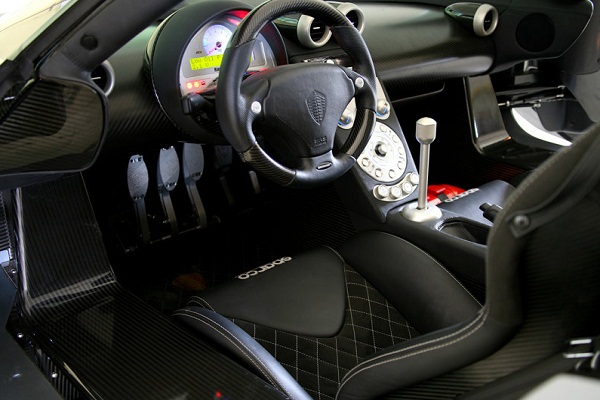
The Koenigsegg CCXR is a mid-engined roadster from Swedish car manufacturer Koenigsegg. The CCXR is powered by a modified twin-supercharged V8 engine from its predecessor the CCX, converted to use E85 or E100 ethanol fuel as well as standard 98 octane petrol. Besides the use of ethanol fuel, the only changes to the engine are modified fuel injectors, upgraded fuel lines and piston rings and a higher boost setting on the superchargers. The increased power of the CCXR, compared to the CCX, is a result of the cooling properties of ethanol in the engine's combustion chambers allowing for a higher pressure in the cylinder and the biofuel having a higher octane rating of 113 RON compared to 95 RON for gasoline in North America and 100 RON for gasoline in Europe. The designer of the CCXR, and founder of Koenigsegg, Christian von Koenigsegg is quoted as saying, "Our engineers couldn't quite believe the figures when we tested the car". In March 2009 the CCXR was chosen by Forbes as one of the ten most beautiful cars in history.
Performance
The CCXR Edition can accelerate from 0–100 km/h (62 mph) in 2.9 seconds and from 0–200 km/h (120 mph) in 8.9 seconds. The CCXR can accelerate from 0–200 km/h (120 mph), then decelerate from 200 120mph)–0km/h, in 13.7 seconds. According to Koenigsegg, the estimated top speed of the CCXR is 400+ km/h (250+ mph), although this has not been officially verified. The braking distance of the CCXR is 32 m (when decelerating from 100 km/h (62 mph).
Engine
The Koenigsegg CCXR engine is a 4.7 litre 288 cu in (4,719 cc) V8, with dual overhead camshafts and 4 valves per cylinder. The engine block is made of Aluminium alloy that has undergone a T7 heat treatment, a form of accelerated precipitation strengthening. The engine has a compression ratio of 8.8:1, is boosted by two Rotrex centrifugal superchargers that provide 1.6 bar of boost, having a patented response charge system for optimal engine response, and is injected by a sequential multipoint fuel injection system. The engine is lubricated with a dry sump system with a separate oil pump, the pistons are cooled by oil sprayed onto them and the oil itself has an external cooler.
The engine produces 1,064 bhp (793 kW; 1,079 PS) at 7200 rpm and 782 lb·ft (1,060 N·m) of torque at 6100 rpm on E100 ethanol fuel. The CCX engine burns 18 L/100 km (16 mpg-imp; 13 mpg-US) on highway travel and 22 L/100 km (13 mpg-imp; 11 mpg-US) on combined travel on E85 ethanol fuel.
Exterior
The CCXR is a two-door, two-seater with a removable hardtop that can be stored under the front hood lid allowing it to be changed at any location. The body, made of pre-impregnated carbon fiber and Kevlar with lightweight sandwich reinforcements, is 169 in (4,300 mm) long, 78.6 in (2,000 mm) wide and 44.1 in (1,120 mm) tall with a ground clearance of 3.94 in (100 mm). The CCXR has a frontal area of 1.867 m2 (2,894 sq in) and a drag coefficient of 0.33. The drag area (frontal area times drag coefficient) is 0.61611 m2 (954.97 sq in). It also has a flat underside with venturi tunnels at the rear and an optional rear spoiler to improve aerodynamics. At 250 km/h (160 mph) there is 100kg of downforce.
Showing posts with label Koenigsegg. Show all posts
Koenigsegg CCX
The CCX was first unveiled on February 28, 2006 at the 2006 Geneva Motor Show although its existence was announced earlier. A derivative known as the CCXR is available, the main difference being that CCXR's engine is tuned to run on biofuel. The different fuel and tune allows the CCXR to produce 25% more power than the CCX. CCX is an abbreviation for Competition Coupé X; the X commemorating the 10th anniversary (being the Roman numeral for ten) of the completion and test drive of the first CC vehicle in 1996. The CCX is 1.6 in (41 mm) taller than the CCR and, combined with the carbon fiber reinforced plastic sports seats by Sparco, the CCX allows for 2 in (51 mm) of extra headroom that Autoweek reviewer Mark Vaughn hypothesizes is "to accommodate U.S. NBA stars." The electronic control unit has also received an upgrade over the CCR meaning that the CCX is without physical fuses and it is lighter than the previous system.
Engine
Previous Koenigsegg models were powered by Ford Modular V8 engines sourced from the U.S. Though also based on the Ford Modular architecture the engine of the CCX was thoroughly re-engineered by Koenigsegg themselves and is assembled at the Koenigsegg factory. The engine block for the dual overhead camshaft, 4 valve per cylinder 4.7 liter 288 cu in (4,719 cc) V8 is cast for them by Grainger & Worrall, a British company that produces drivetrain components for Formula One cars. The engine block is made of 356 Aluminium that has undergone a T7 heat treatment, a form of accelerated precipitation strengthening. The aluminium alloy is stronger than the previous engine and allows a thinner, thus lighter, engine block that will withstand higher cylinder pressures. The engine is boosted by two centrifugal superchargers that provide 17.5 psi (1.2 bar) of boost with an 8.2:1 compression ratio. The engine produces 806 bhp (601 kW; 817 PS) at 6900 rpm and 678 lb·ft (919 N·m) of torque at 5700 rpm on 91 octane (U.S. rating) gasoline. The engine is lubricated with a dry sump system with a separate oil pump, the pistons are cooled by oil sprayed onto them and the oil itself has an external cooler. The CCX does 14 mpg (17 l/100 km) in combined cycle and 18 mpg (13 l/100 km) in highway travel.
Performance
The CCX can accelerate from 0–62 mph (100 km/h) in 3.2 seconds and from 0–124 mph (200 km/h) in 9.8 seconds. According to Koenigsegg it has a top speed of approximately 250 mph (400 km/h), although this has not been officially verified. On 15 June 2008, a standard fully equipped CCX was independently timed by sport auto in achieving a record 0-186-0 mph (0-300–0 km/h) in 29.2 seconds, beating the Mercedes-Benz McLaren SLR 722 Edition, the Lamborghini Murciélago LP640, the Porsche 997 GT2, the Alpina B6 S (based on the BMW 6 Series), and the Corvette Z06.
Koenigsegg CCR
The CCR is based on the Koenigsegg CC8S, featuring more power and higher performance. The improved-power engine was made possible by the use of a Lysholm twin-screw supercharger and a new titanium exhaust system. This takes the power output to a maximum of 806 hp (601 kW) at 6,900 rpm. Torque is also distributed evenly and peaks at 920 N·m (678 ft·lbf) at 5,700 rpm. Newer versions (the Koenigsegg CCX) appear to use twin Rotrex centrifugal type superchargers instead, providing the same power, but lowering the peak torque point from 5,700 to 5,400 rpm. (Note: This information of performance is partially updated in their official page.)
Externally the CCR looks similar to the CC8S, but features a new side air-intake design, a tweaked headlight arrangement, a revised rear-end, larger brakes, more power and new front splitters for optimized downforce. Like the CC8S, the CCR is a two-seat coupe with a mid-engine, featuring large scissor doors that open by rotating up and forward.
To honour the Swedish Fighter Jet Squadron No. 1, (Johan röd) which had occupied the current facility of Koenigsegg, the CCR is adorned with a symbol of a ghost, the symbol of the squadron.
On a History Channel special on the CCR (Aug, 2006), Koenigsegg states that the base price for the CCR is approximately US$590,000.
On February 28, 2005, at 12.08 local time, the Koenigsegg CCR broke the production road car speed record, achieving a new official top speed of 387.87 km/h (241 mph) at Italy's Nardo Prototipo proving ground. A team of five Koenigsegg engineers and mechanics together with founder Christian von Koenigsegg ran a technically standard CCR, driven by famous supercar test driver and veteran record breaker Loris Bicocchi. The car was clocked using Tag Heuer´s Splitmaster 650 with photocells stationary at the track, recording the average speed during 1 km.
The CCR took the record from the McLaren F1, which held the record for over 10 years of 386.7 km/h, set on the 9 km straight track at the VW Ehra facility in Wolfsburg, Germany. The CCR ran on the Nardo/Prototipo track, a circular track with a circumference of 12.5 km. This means that the car is driven in a constant turning motion, which makes the exercise and speed even more impressive. The steering wheel at this speed is kept at around 30 degrees of constant angle, a fairly sharp angle for the speed. On the same track, the F1 managed an unofficial record of 372 km/h.
In May, 2005 not long after the CCR claimed the record, a prototype of long awaited Bugatti Veyron took the crown with a top speed over 400 km/h (249 mph). The final production model of the Veyron reached a speed of 407.5 km/h (253.2 mph) in the hands of Car and Driver in their November 2005 issue.
2011 Koenigsegg Agera
2011 Koenigsegg Agera,
fast car,
hot car,
Koenigsegg,
Koenigsegg Agera,
super car,
Turbo Car
11:32 PM
Koenigsegg will surprise us with a new supercar next week at the Geneva Motor Show in Geneva. Called "AGERA"(which means "to act" in Swedish or "ageless"in Greek), the new supercar will be limited to 16-20 cars per year. The first orders will be taken at the Geneva Motor Show, while the first customers will receive their cars at the end of the year.
The Agera is powered by the same 4.7-liter V8 that delivers 910hp at 6850rpm total-redline and a maximum torque of 1100nm at 5100rpm. The car only weights 2832 pounds and de0 sprints to 62 mph in 3.1 seconds and 124 mph in 8.9 seconds. Top speed climbs to over 245 mph.The Agera latest features in braking technology, integrating an adjustable system ABS, 392 × 36 × 34 and 380 drilled and ventilated ceramic discs. Also a first in the automotive industry is the interior illumination: the light Ghost. The light shines through the machined aluminum buttons and the surfaces of nanotubes by invisible, creating excellent visibility of symbols, as well as a very clean and elegant, surrounded by a carbon center fbre any new console and tunnel assembly.
Koenigsegg celebrate 15 years of making dream cars, by unleashing their latest jewel – the Koenigsegg Agera. A new supercar aimed to take the Koenigsegg experience to the next level, both on the road and the track.
Agera, the Swedish verb “to act”, has been chosen as the name for Koenigsegg´s latest super creation, as it symbolizes the Koenigsegg philosophy well. Koenigsegg is always striving forward, seeking challenges beyond limitations. The new supercar Agera is an outcome of that creative process and its functions respond very well to the given name.
When we believe in something, we do it. We act. the car also has to act, when commanded to unleash its performance, forcefully and fawlessly. The development of the Agera has been evolutionary, following the Koenigsegg tradition of continuous improvements, by honing and perfecting the end result, all based on previous experience and innovative mindsets. The focus when developing the Agera was to maximize, driving experience, cornering speed, braking and adaptability, says Christian von Koenigsegg.
Koenigsegg Agera Testament to Time
The Koenigsegg Agera is a testament to time. The original shape and concept of the Koenigsegg CC, created 15 years ago, is still valid, fresh and highly competitive today. The Agera still stay true to the original philosophy, shape and size of the original CC. At the same time, it looks, feels and performs like something belonging to the future, with all new content.
A Supercar is not better than the tires it use, as it is the only link between the road and the car. Therefore Koenigsegg has a deep and long term collaboration with Michelin, when it comes to tire development. The Agera program will take this collaboration to the next level and is expected to set new standards when it comes to overall performance -wet as well as dry handling. The Agera is as wide at the front as in the rear of the car. This gives very good balance in corners and minimizes body roll.
The Agera also features the latest in braking technology, incorporating an adjustable ABS system, 392×36 and 380×34 ventilated and drilled ceramic discs, for unparalleled braking performance and zero fade regardless of track or road condition.Thanks to optimized breathing and Twin Turbo, power is now 910 hp, running on regular petrol. Torque is maximum 1100 nm and is reached at 5100 rpm. There is over 1000 nm of torque available from 2680 to 6100 rpm.
2011 Koenigsegg Agera R Turbo Car
2011 Koenigsegg Agera R Turbo Car,
fast car,
hot car,
Koenigsegg,
Koenigsegg Agera R,
Turbo Car
11:17 PM
Koenigsegg Agera R will debut in 2011 World Auto Show in Geneva, it was the paint scheme inspired by Speed Racer and pack so much power. Koenigsegg Agera R car shown in Geneva is a very special guest.
Koenigsegg Agera R is equipped with a special roof section featuring a carbon fiber integrated Thule ski box containing two pairs of skis Koenigsegg. It has quality materials and very high R Agera certainly does not disappoint. With a monocoque carbon fiber serving as its backbone, R is Agera is equipped with Vortex Generation Rim (VGR) wheels. The design of rays to generate a turbine effect which helps to create support.
It was just a year ago when Koenigsegg debuted the Agera in Geneva packing a twin-turbo 4.7-liter V8 with 910 PS (669 kW / 898 hp) and 1100 Nm (811 lb-ft) of torque. With performance specs such as 0-100 km/h in 3.1 seconds, top speed of 390+ km/h (245+ mph) it certainly lands itself firmly in the hypercar category.
2011 Koenigsegg Agera R is “slightly” improved, It was powered by a larger 5.0-liter twin-turbo V8 producing an earth moving 1115 PS of torque. A pretty astonishing figure but one crucial detail in achieving that number is the fuel. Fill it up with 95-octane fuel and the engine’s potential is limited to 940 PS (927 bhp / 691 kW) and 1100 Nm (811 lb-ft) torque while full potential is only unleashed with the use of E85 biofuel.
No performance specs have been released, Koenigsegg is keen to mention the Agera R Special Michelin tires were developed specifically for the Agera R and hold a speed rating of up to 260 mph (419 km/h), the highest-speed-rated tires in the world, according to Koenigsegg.

2011 Koenigsegg Agera R Turbo Car
The Koenigsegg Agera R will make its global debut in 2011 Geneva auto show, it was the Speed Racer-inspired paint scheme and the packing so much power. Koenigsegg Agera R car shown in Geneva is a very special customer.
Koenigsegg Agera R comes equipped with a special roof section featuring an integrated Thule carbonfibre ski-box containing two pairs of Koenigsegg skis. It has some pretty-high quality materials and the Agera R certainly doesn’t disappoint. With a carbon fiber monocoque serving as its skeleton, the Agera R is is equipped with Vortex Generating Rim (VGR) wheels. The design of the spokes generate a turbine effect which help in creating some downforce.
It was just a year ago when Koenigsegg debuted the Agera in Geneva packing a twin-turbo 4.7-liter V8 with 910 PS (669 kW / 898 hp) and 1100 Nm (811 lb-ft) of torque. With performance specs such as 0-100 km/h in 3.1 seconds, top speed of 390+ km/h (245+ mph) it certainly lands itself firmly in the hypercar category.
2011 oenigsegg Agera R is “slightly” improved, It was powered by a larger 5.0-liter twin-turbo V8 producing an earth moving 1115 PS of torque. A pretty astonishing figure but one crucial detail in achieving that number is the fuel. Fill it up with 95-octane fuel and the engine’s potential is limited to 940 PS (927 bhp / 691 kW) and 1100 Nm (811 lb-ft) torque while full potential is only unleashed with the use of E85 biofuel.
No performance specs have been released, Koenigsegg is keen to mention the Agera R Special Michelin tires were developed specifically for the Agera R and hold a speed rating of up to 260 mph (419 km/h), the highest-speed-rated tires in the world, according to Koenigsegg.
Subscribe to:
Posts (Atom)